
The Late Cretaceous is known as a warm period in Earth’s history, with temperate forests and dinosaurs inhabiting regions near the Arctic. Yet climate models have long struggled to reproduce the high temperatures inferred from geological evidence. Using a coupled atmosphere–ocean–vegetation climate model, researchers showed that variations in the orbit parameters, particularly changes in the obliquity, had a much larger influence on Arctic temperatures under Late Cretaceous geography than they do today. The findings suggest that the Late Cretaceous continental configuration amplified orbital climate forcing, helping explain the surprisingly warm polar climates of the dinosaur era.
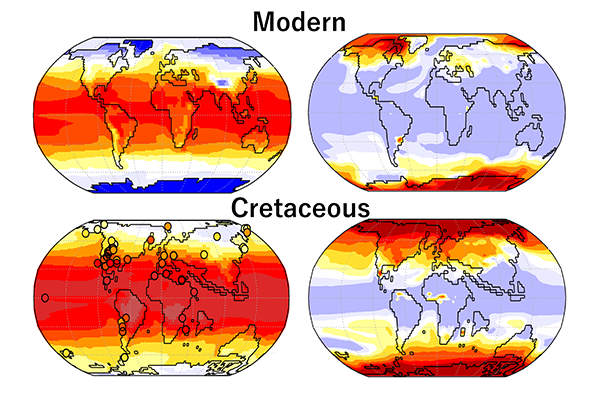
The Late Cretaceous, around 70 million years ago, was a greenhouse world. Global temperatures were substantially warmer than today, sea levels were higher, and temperate vegetations and dinosaurs inhabited environments stretching far into the polar regions. Geological evidence indicates that Arctic temperatures during this period were remarkably high, supporting forests and diverse ecosystems at high latitudes in the Northern Hemisphere. Yet reproducing these warm polar conditions in climate models has remained a longstanding challenge. Even simulations using elevated carbon dioxide concentrations often underestimate temperatures inferred from geological records.
To investigate this discrepancy, Taro Higuchi, a researcher now at the Earth-Life Science Institute (ELSI), Institute of Science Tokyo, together with Professor Ayako Abe-Ouchi and colleagues at the University of Tokyo and the Institute of Science Tokyo, explored a factor that has received comparatively little attention in studies of past warm climates: variations in the orbital parameters. The majority of this research was conducted while Higuchi was at the University of Tokyo. Using the atmosphere–ocean–vegetation coupled climate model MIROC4mV, the team conducted a large suite of simulations of the Maastrichtian, the final stage of the Cretaceous. They systematically varied the orbital parameters—including obliquity, precession, and orbital eccentricity—and compared the results with equivalent experiments using modern geography.
The simulations revealed that accounting for the full range of orbital configurations substantially improved agreement between climate-model results and geological temperature estimates from high latitudes. In particular, changes in obliquity had a much larger influence on northern polar temperatures under Late Cretaceous geography than under modern conditions. This enhanced sensitivity helped bridge the gap between model predictions and geological evidence, reducing discrepancies that have persisted in previous studies.
Why was the response so different between the Late Cretaceous and Modern geographers? The answer lies in the geography of the past Earth. During the Late Cretaceous, there were no large continental ice sheets like those that cover Greenland and Antarctica today. In addition, extensive landmasses occupied northern high latitudes. These Late Cretaceous geographical features amplified key feedback processes—such as spring-to-summer snow and sea ice retreat, heat absorption into the oceans, autumn-to-winter heat release from the oceans, and increased atmospheric water vapor—that drive polar warming in response to changes in orbital parameters. The study found that the combination of ice-free polar regions and a different land–sea distribution made the Cretaceous Arctic substantially more responsive to orbital forcing than the modern Arctic.
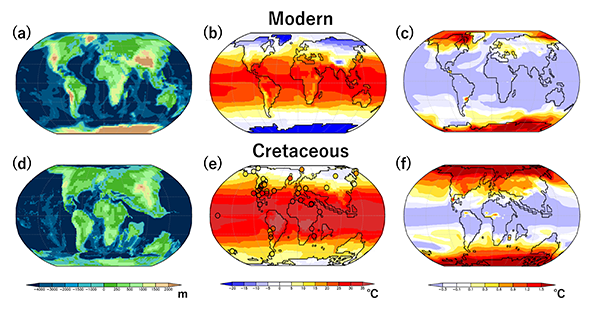
These results suggest that the orbital parameters and the continental distribution of the Late Cretaceous played a key role in solving the mystery of Arctic warming during the age of the dinosaurs. Furthermore, by improving our understanding of Arctic warming in the period, this study provides new validation for the reliability of climate models used to reconstruct paleoclimates. Going forward, conducting similar experiments and analyses for other geological periods and integrating geological data with climate models are expected to deepen our understanding of surface environment fluctuations in polar regions throughout Earth’s history, as well as further enhance the precision of past global environment reconstructions.
| Journal | Geophysical Research Letters |
| Title of the paper | Enhanced Orbital-Forcing Sensitivity of Northern High Latitude Temperatures in the Late Cretaceous Relative to Modern Geography |
| Authors | Taro Higuchi1,2, Ayako Abe‐Ouchi1, Wing‐Le Chan1 and Ryouta O’ishi1,3 |
| Affiliations | 1. Atmosphere and Ocean Research Institute, the University of Tokyo, Kashiwa, Japan 2. Now at Earth‐Life Science Institute Institute of Science Tokyo, Meguro, Japan 3. Now at Department of Earth and Planetary Sciences, Institute of Science Tokyo, Meguro, Japan |
| DOI | 10.1029/2025GL120337 |
| Online published date | 22 July 2026 |