
<Press Release>
Researchers identify a mineral-mediated chemical pathway for hydrogen cyanide production, compatible with our current understanding of Earth’s history
Manganese dioxide can convert amino acids into hydrogen cyanide (HCN) without requiring methane, solving a long-standing puzzle about the origin of this key prebiotic molecule on early Earth, as reported by researchers from Science Tokyo. Although HCN is central to origin-of-life theories, recent evidence suggests early Earth’s atmosphere didn’t contain sufficient methane needed for classic HCN-producing reactions. The newly found chemical pathway shows that HCN could instead have been continuously supplied from abundant amino acids.
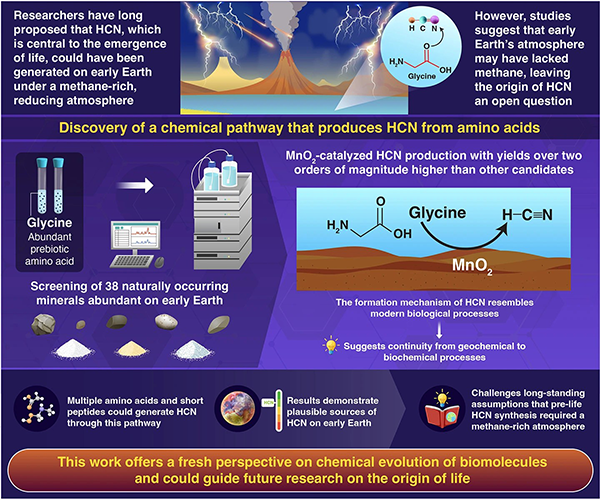
The question of how life first emerged on Earth has been the subject of intense scientific research for decades. At the center of many origin-of-life theories lies hydrogen cyanide (HCN), a small but highly reactive molecule that can give rise to a wide range of biological building blocks. Several laboratory studies, such as the landmark Miller-Urey experiment in 1953, have shown that HCN can produce various amino acids, nucleobases, and sugars under methane-rich conditions with reducing atmosphere, providing the chemical ingredients needed for life on early Earth.
However, recent geological evidence has cast doubt on a long-standing model regarding the origin of HCN itself. Scientists have found that early Earth’s atmosphere most likely did not contain abundant methane, which is a key ingredient in classic HCN-producing reactions. If methane levels were indeed low, it raises an important question: Where did HCN on early Earth come from?
Seeking to address this puzzle, a research team led by Professor Ryuhei Nakamura and Dr. Yamei Li from the Earth-Life Science Institute (ELSI), Institute of Science Tokyo (Science Tokyo), Japan, investigated alternative ways that HCN might have formed on our planet over 3 billion years ago. Their findings, made available online on March 23, 2026, and published in Volume 123, Issue 13 in the journal Proceedings of the National Academy of Sciences on March 31, 2026, describe a previously unrecognized chemical pathway that generates HCN in a way that is compatible with our modern understanding of Earth’s history.
For a full press release, please visit Science Tokyo website