
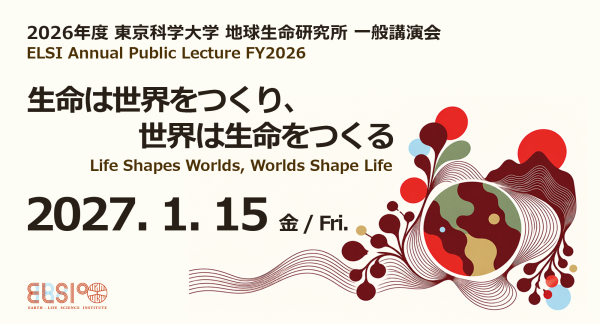
ELSI Annual Public Lecture FY2026 will be held on Friday, 15 January 2027. The theme of the lecture is ‘Life Shapes Worlds, Worlds Shape Life,’ and the event will feature ELSI’s Associate Professor Tetsuhiro S. Hatakeyama and Paula Prondzinsky, Postdoctoral Researcher at the Japan Agency for Marine-Earth Science and Technology (JAMSTEC). The event is moderated by ELSI’s Professor Ryuhei Nakamura. The first lecture will be in Japanese, and the second will be in English. There will be simultaneous interpretation. This is an on-site event, and there will be no live streaming.
Date and time: Friday, 15 January 2027, 19:00-20:50 (Doors open at 18:30)
Theme: Life Shapes Worlds, Worlds Shape Life
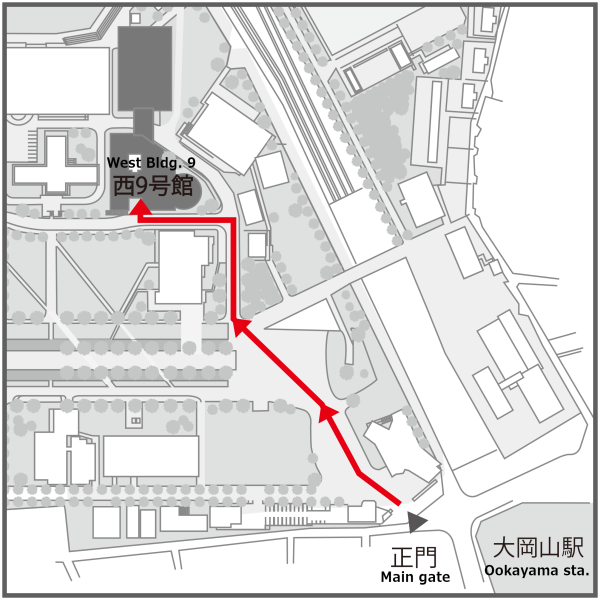
Venue: Multi-Purpose Digital Hall, Ookayama West Bldg. 9, Institute of Science Tokyo (Ookayama station, Tokyu Line, 3 min. walk)
Organiser: Earth-Life Science Institute (ELSI), Institute of Science Tokyo
Lecturers:
Tetsuhiro S. Hatakeyama (Associate Professor, ELSI)
Paula Prondzinsky (Postdoctoral Researcher, JAMSTEC)
Moderator: Ryuhei Nakamura (Professor, ELSI)
Language: Japanese/English (Simultaneous interpretation)
Fee: Free
Registration: Prior registration is required. Capacity is limited to 300 participants.
https://elsi-public-lecture-20270115.peatix.com
Registration Deadline:
Noon on Thursday, 14 January 2027, or earlier if capacity is reached.
Contact: pr@elsi.jp
Lecture 1
What is universal about life?
Tetsuhiro S. Hatakeyama
Associate Professor, ELSI

Abstract:
Life on Earth is astonishingly diverse, yet simple, shared principles may underlie metabolism, cellular growth, responses to the environment, and evolution. Would the same principles hold if life evolved on a very different world? Drawing on theoretical studies of living systems, this talk explores the universality hidden beneath life’s diversity and asks what life on Earth might share with life elsewhere.
Bio:
Tetsuhiro S. Hatakeyama is an Associate Professor at the Earth-Life Science Institute (ELSI), Institute of Science Tokyo. He received his PhD from the University of Tokyo and has previously held research positions at RIKEN and the University of Tokyo. Using theoretical biophysics and complex systems science, he investigates metabolism, cellular growth, and evolution to uncover the universal principles that underlie the remarkable diversity of living systems.
Lecture 2:
How does microscopic life shape a planet?
Paula Prondzinsky
Postdoctoral Researcher, JAMSTEC

Abstract:
Microbes inhabit every environment on Earth, from extreme habitats such as polar regions, deserts, and the deep sea to familiar environments around us. By studying their DNA and growing them in the laboratory, scientists are uncovering how these tiny organisms evolved and how they survive in environments once thought uninhabitable. In this talk, we will explore how microorganisms have shaped Earth’s ecosystems for billions of years and continue to drive processes that sustain life today.
Bio:
Paula Prondzinsky is a postdoctoral researcher at the Japan Agency for Marine Earth Science and Technology (JAMSTEC). She received her PhD from the Earth-Life Science Institute (ELSI) at Institute of Science Tokyo, investigating how microbes survive in some of Earth’s most extreme environments. Her current research explores how Earth’s most abundant marine microorganisms influence the chemistry, ecology, and evolution of the sunlit ocean.
Moderator
Ryuhei Nakamura
Professor, ELSI

Please click here to download the flyer.
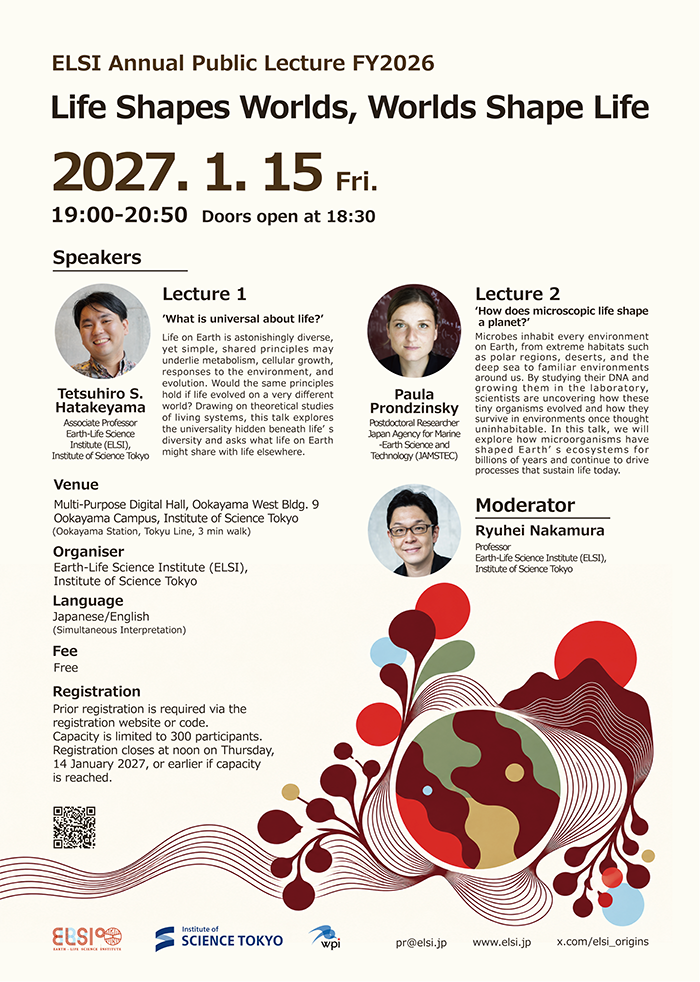
(Credit for the portrait photos of Paula Prondzinsky and Ryuhei Nakamura:Nerissa Escanlar/ELSI)