
[Press Release]
Chemical reactions beneath kilometre-thick ice sheets could have consumed greenhouse gases and prolonged global glaciations
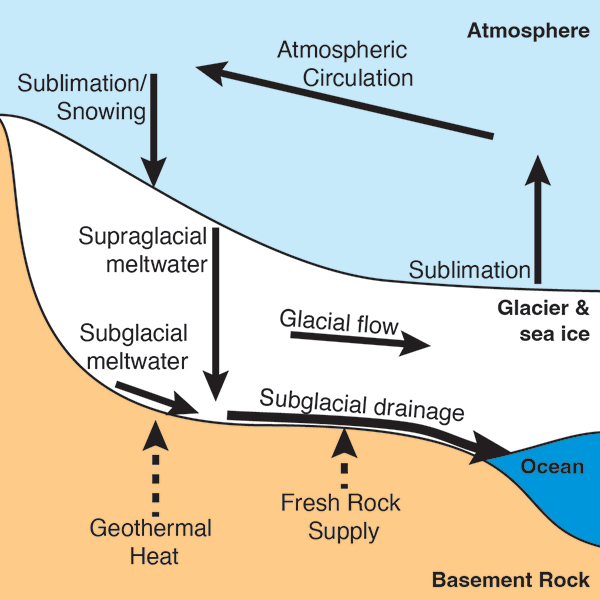
Water (H2O) sublimates from the sea ice surface, is transported via atmospheric circulation, and is then deposited as snow or re-sublimated at high altitudes. This water transport is ultimately balanced by a subglacial drainage system and glacial flow. Credit: Adopted from Shintaro Kadoya and Mohit Melwani Daswani (2026). Earth and Planetary Science Letters
A new study led by researchers at the Earth-Life Science Institute (ELSI) at Institute of Science Tokyo challenges a long-standing assumption about Earth’s most extreme ice ages. Using numerical geochemical models, the team showed that chemical weathering may have continued beneath thick continental ice sheets during the snowball Earth event, consuming atmospheric carbon dioxide (CO₂) and potentially prolonging the global glaciation. The findings provide a new explanation for the unusually long duration of some ancient global glaciations.
“Our results demonstrate that subglacial weathering represents a previously unrecognised feedback mechanism that could account for the dramatically different durations of Neoproterozoic snowball Earth events,” says Shintaro Kadoya, lead author of the study and a Specially Appointed Assistant Professor at ELSI, Institute of Science Tokyo.
Earth’s climate has not always been stable. Several times in its history, the planet entered periods so cold that ice extended from the poles to near the equator. These global glaciations, known as snowball Earth events, dramatically altered Earth’s surface environment and played a key role in shaping the evolution of climate, oceans, and life. Yet one of its most puzzling features remains unexplained: why some snowball Earth events lasted far longer than others.
Two of the most prominent snowball Earth episodes occurred during the Neoproterozoic era, between about 720 and 635 million years ago. Geological evidence indicates that the older Sturtian glaciation lasted four to fifteen times longer than the later Marinoan glaciation, despite occurring under broadly similar conditions. Scientists have long debated what could account for this striking difference in duration.
The traditional explanation for the deglaciation of global glaciation focuses on the carbon cycle. Under normal conditions, atmospheric CO₂ is regulated by a balance between volcanic emissions and chemical weathering of rocks on land. When temperatures rise, weathering accelerates, drawing down CO₂ and cooling the climate. During global glaciations, however, continents are assumed to have been covered by ice and largely devoid of liquid water, effectively shutting down silicate weathering. In this view, CO₂ would gradually accumulate in the atmosphere through volcanic outgassing until greenhouse warming became strong enough to melt the ice and end the snowball Earth state.
Recent geological observations have begun to challenge this simple picture. Minerals such as dolomite, whose precipitation strongly relies on continental weathering, appear to have precipitated during at least some snowball Earth intervals. These findings raise the possibility that chemical reactions between water and rock may have continued beneath glaciers, even when Earth’s surface was frozen.
To investigate this possibility, the research team developed numerical models of water–rock interactions in subglacial environments. Their simulations focused on conditions beneath thick continental ice sheets, where geothermal heat from Earth’s interior and insulation by overlying ice can generate meltwater at the glacier base. This meltwater can flow through crushed rock produced by glacial erosion, allowing chemical reactions to proceed even in a globally frozen climate.
The models track how dissolved elements, secondary minerals, and fluid chemistry evolve as meltwater interacts with fresh rock. A key finding is that the efficiency of subglacial weathering is controlled by the balance between water supply and the rate at which fresh rock is delivered by glacial erosion. When this balance remains constant, the system reaches a stable chemical state, regardless of the absolute amount of water or rock involved.
Under plausible snowball Earth conditions, the researchers found that subglacial weathering could consume significant amounts of CO₂. In some scenarios, the estimated CO₂ consumption rates can approach those of volcanic CO₂ emissions under favourable snowball Earth conditions, meaning that weathering beneath ice sheets could effectively offset greenhouse gas buildup. This process would slow atmospheric warming and delay deglaciation, helping to explain why some snowball Earth events, such as the Sturtian glaciation, persisted for tens of millions of years.
The study also suggests that differences in subglacial hydrology and erosion rates could lead to large variations in weathering intensity between different glaciations. Even modest changes in meltwater availability or rock supply could shift the balance between CO₂ consumption and accumulation, potentially accounting for the contrasting durations of Neoproterozoic snowball Earth events. Co-author Mohit Melwani Daswani, Associate Professor at ELSI, Institute of Science Tokyo adds, “This finding challenges a central assumption of the classical snowball Earth hypothesis by showing that weathering can continue beneath ice sheets and significantly influence climate.”
Beyond climate, subglacial weathering may also have influenced ocean chemistry and nutrient supply. Models indicate that meltwater flowing from beneath ice sheets could have delivered elements such as phosphorus to the oceans, with possible consequences for biological productivity once the ice retreated. This highlights subglacial environments as dynamic chemical reactors rather than inert frozen landscapes.
Together, these findings point to subglacial weathering as a previously underappreciated feedback in Earth’s climate system. By continuing to consume CO₂ during global glaciations, chemical reactions beneath ice sheets may have played a crucial role in regulating the timing and duration of Earth’s most extreme ice ages.
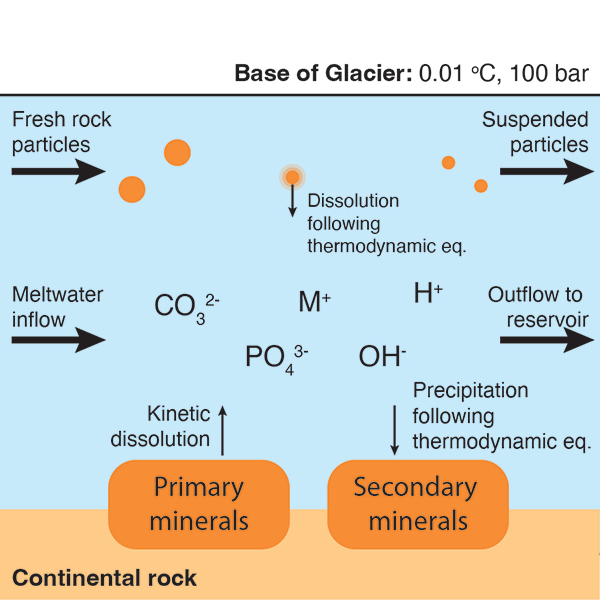
Under a flowing system, minerals dissolve into the water and precipitate as secondary minerals. In addition to the primary minerals already within the reaction system, the continuous supply of fresh rock particles, produced by glacial erosion, is also taken into account. Credit: Adopted from Shintaro Kadoya and Mohit Melwani Daswani (2026). Earth and Planetary Science Letters
Reference
Shintaro Kadoya¹*, Mohit Melwani Daswani¹,², Continued continental weathering during snowball Earth mitigated greenhouse gas buildup and prolonged global glaciation, Earth and Planetary Science Letters, DOI: 10.1016/j.epsl.2026.119837
1. Earth-Life Science Institute, Institute of Science Tokyo, 2-12-1, Ookayama, Meguro-ku, 152–8550, Tokyo, Japan
2. Jet Propulsion Laboratory, California Institute of Technology, 4800 Oak Grove Dr. M/S 301, Pasadena, CA, USA
*Corresponding author’s email: skadoya@elsi.jp
Contacts:
Thilina Heenatigala
Director of Communications
Earth-Life Science Institute (ELSI),
Institute of Science Tokyo
E-mail: thilinah@elsi.jp
Tel: +81-3-5734-3163 / Fax: +81-3-5734-3416
Shintaro Kadoya
Specially Appointed Assistant Professor
Earth-Life Science Institute (ELSI),
Institute of Science Tokyo
E-mail: skadoya@elsi.jp