
Every living cell relies on molecular “currencies” such as ATP, GTP and NAD(P)H to transfer energy and coordinate metabolism. Although these molecules perform different cellular functions, they are chemically connected, making their independent regulation surprisingly difficult. Researchers at ELSI and collaborators developed a new theoretical framework showing that cells face a fundamental tradeoff: maintaining multiple energy currencies at similar abundances allows more precise metabolic control, but requires greater energy dissipation. The work offers a thermodynamic explanation for why cells organise their energy economy the way they do and suggests a new link between metabolism, environmental complexity and the evolution of microbial genomes.
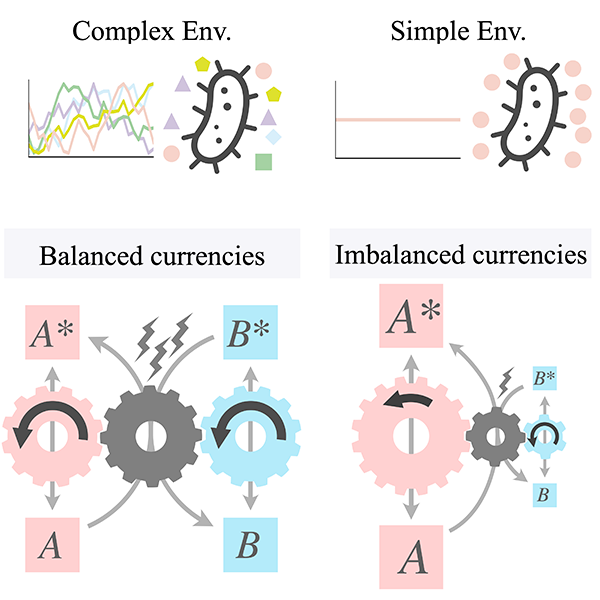
The theory predicts that balanced energy currencies enable greater metabolic control, but require more thermodynamic dissipation. In simpler environments, imbalanced currencies can reduce this cost, albeit at the expense of metabolic flexibility, and vice versa. Credit: Yamagishi, J.F. et al., PRX Life (2026)
Life depends on the continuous flow of energy. Every cell must capture energy from its environment, store it, and distribute it to thousands of biochemical reactions occurring simultaneously. Rather than relying on a single universal energy carrier, cells employ several different “currency metabolites”—including ATP, GTP and NAD(P)H—each specialising in particular cellular processes such as biosynthesis, protein production and signalling. Yet these currencies are not independent. Biochemical reactions continually exchange energy between them, raising a longstanding question: why has evolution maintained multiple interconnected energy currencies instead of a simpler system?
In a new theoretical study, Jumpei Yamagishi, a postdoc at the Washington University in St. Louis (a postdoc in RIKEN and the University of Tokyo at the time of research), and Tetsuhiro S. Hatakeyama (ELSI) developed a unified physical theory to investigate this question. Drawing on stochastic thermodynamics, they constructed a minimal mathematical model that captures how different metabolic currencies exchange energy while remaining under cellular control. Rather than modelling the full complexity of metabolism, the framework focuses on the essential interactions between coupled currency metabolites, revealing general physical principles that apply across living systems.
The model uncovered a fundamental tradeoff between metabolic controllability and thermodynamic cost. When different currency metabolites exist in similar amounts inside a cell, each can be regulated relatively independently. This gives cells greater flexibility to respond to changing environmental conditions and coordinate different metabolic pathways. However, maintaining this flexibility comes at a cost: energy is continually dissipated as heat, increasing the system’s entropy production rate. Conversely, when one currency metabolite greatly outnumbers the others, it behaves like a reservoir that constrains their behaviour. This reduces the energy dissipated by the system but also limits the cell’s ability to regulate different metabolic processes independently.
The authors suggest that this tradeoff may help explain how organisms adapt to different environments. Microbes living in complex and fluctuating habitats must continually adjust their metabolism in response to changing nutrients and environmental conditions. Such organisms are predicted to benefit from maintaining more balanced pools of currency metabolites, sacrificing energetic efficiency for greater metabolic flexibility. By contrast, organisms inhabiting simple or stable environments may gain an advantage by maintaining more uneven currency pools, reducing thermodynamic costs while accepting more limited metabolic control.
The theory also provides a potential explanation for a longstanding puzzle in microbial evolution: the remarkable diversity of genomic GC content. Previous studies have shown that bacteria living in simple, stable environments—such as intracellular symbionts—often evolve genomes with lower GC content, but the underlying physical reason has remained unclear. The authors propose that because ATP and GTP pools are linked to nucleotide composition, the same thermodynamic tradeoff governing metabolic currencies could favour lower GC content in organisms where metabolic controllability is less critical. Their analysis of genomic and evolutionary datasets is consistent with this hypothesis, providing a testable connection between cellular thermodynamics and genome evolution.
By connecting nonequilibrium thermodynamics, systems biology and evolutionary theory, the study offers a new way of thinking about cellular metabolism. Rather than viewing ATP, GTP and other currency metabolites simply as biochemical components, it treats them as part of an economic system in which flexibility and efficiency cannot both be maximised. This framework not only provides insight into the organisation of modern cells but also establishes a general physical principle that may apply across diverse forms of life.
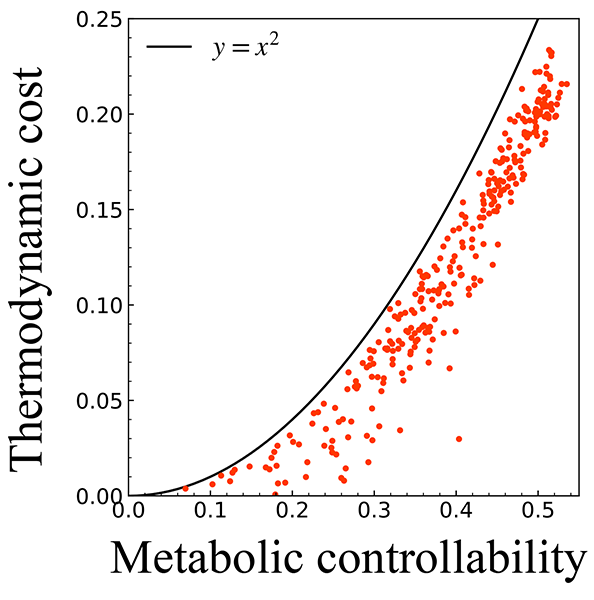
Greater metabolic controllability comes with a higher thermodynamic cost. The black curve shows the theoretical prediction, while the red dots show numerical results for randomly chosen parameter values. Credit: Yamagishi, J.F. et al., PRX Life (2026)
| Journal | PRX Life |
| Title of the paper | Thermodynamic Cost-Controllability Tradeoff in Metabolic Currency Coupling |
| Authors | Jumpei F. Yamagishi1, 2*, Tetsuhiro S. Hatakeyama3 |
| Affiliations | 1. Center for Biosystems Dynamics Research, RIKEN, 6-7-1 Minatojima-minamimachi, Chuo-ku, Kobe 650-0047, Japan 2. Universal Biology Institute, The University of Tokyo, 7-3-1 Hongo, Tokyo 113-0033, Japan 3. Earth-Life Science Institute, Institute of Future Science, Institute of Science Tokyo, Tokyo 152-8550, Japan |
| DOI | https://doi.org/10.1103/4bqh-zhry |
| Online published date | 3 September 2026 |