
Discovering evidence of life beyond Earth would attract extraordinary public attention, but the scientific evidence is unlikely to arrive as a single, unambiguous moment of discovery. Scientists, journalists, communicators, historians and philosophers gathered at a Lorentz Center workshop to consider how the search for life elsewhere should be communicated as evidence develops. Their recommendations emphasise transparency about uncertainty, realistic expectations, independent verification, careful use of language and imagery, and sustained public engagement. The resulting paper argues that preparing for communication before a potential discovery occurs will be essential for maintaining scientific rigour and public understanding.
Few scientific announcements could attract as much attention as the discovery of life beyond Earth. Yet such a discovery is unlikely to arrive as a single definitive moment. A possible biosignature in an exoplanet atmosphere, unusual chemistry in material returned from Mars, or evidence from an icy moon would need to be interpreted, challenged and independently verified. What initially appears to be evidence for life may later prove to have a non-biological explanation. Communicating this process presents an unusual challenge: how can scientists convey the significance of a potentially profound discovery while remaining clear about what the evidence does, and does not, show?
Recent history demonstrates why this matters. Claims involving arsenic-tolerant bacteria, phosphine in the atmosphere of Venus, and possible biosignatures in the atmosphere of the exoplanet K2-18b have generated widespread media attention while the underlying evidence remained contested or was subsequently reinterpreted. Such cases illustrate the iterative nature of science, but they also show how tentative findings can enter public discussion framed as major steps towards discovering extraterrestrial life.
To consider how the scientific community could better prepare, an interdisciplinary group of scientists, historians, philosophers, science journalists and press information officers met at the Lorentz Center in Leiden, the Netherlands, in September 2024 for the workshop Breaking News: We Found Extraterrestrial Life! Rather than attempting to predict how or when life might be found, participants explored how different detection scenarios could unfold and how research results should be communicated to the public. The resulting paper, published in Astrobiology, synthesises the discussions into recommendations for communicating the search for life elsewhere. Two ELSI researchers, Thilina Heenatigala and Harrison B. Smith, contributed as co-authors, with Heenatigala also serving on the workshop organising committee.
Central to the recommendations is transparency about uncertainty. A potential biosignature should not be communicated as equivalent to evidence of life, and terms such as “biosignature”, “habitability” and even “water” require careful explanation. The authors recommend distinguishing clearly between what has been observed, what can reasonably be inferred from those observations, and what remains unknown. Communication should also acknowledge that science is iterative: interpretations can change as new observations become available and other researchers test the evidence.
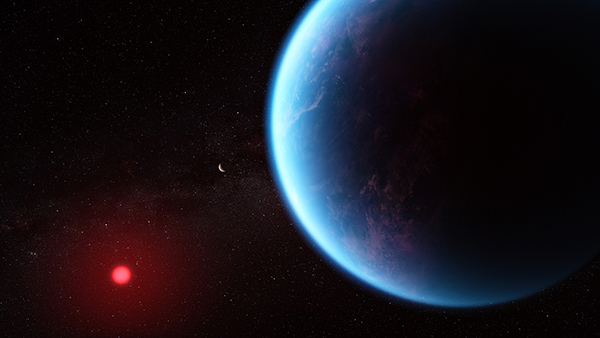
Language and imagery can strongly influence how such discoveries are understood. Terms such as “Earth twin” or “Earth-like” can imply far more than observations actually establish, while an artist’s impression of an exoplanet may inadvertently appear to show something directly observed. The paper recommends using more precise terminology, clearly identifying artistic and AI-generated imagery, and, where possible, presenting visual interpretations alongside the scientific data from which they were derived.
The authors also caution against treating every new result as another step on an inevitable path towards finding life. Promises that detection is imminent, particularly when accompanied by specific timelines or probabilities, can create unrealistic expectations. Instead, communication should reflect the incremental and sometimes nonlinear nature of scientific progress. Independent expert perspectives, accessible data, peer review and continued scrutiny should be presented not as obstacles to discovery, but as fundamental parts of establishing whether an extraordinary claim is reliable.
Preparation must also extend beyond the most familiar scenarios. During the workshop, participants considered possible discoveries involving exoplanets, icy moons, Mars samples and technosignatures, but also less conventional situations: a detection announced by citizen scientists using archival data, a private company withholding its underlying observations, or future astronauts encountering possible microbial life on Mars. Such scenarios introduce questions of access, commercial interests, planetary protection, culture and ethics that cannot be addressed through scientific evidence alone.
Ultimately, the paper argues that responsibility for communicating a possible discovery of extraterrestrial life cannot rest with scientists alone. Researchers, institutional communicators, journalists, educators and social scientists all have roles to play, while communication itself must account for different cultural contexts and audiences around the world. Preparing these relationships and practices now may allow society to approach a future life-detection claim not simply as a dramatic announcement, but as what it is likely to be: a complex scientific process in which evidence, interpretation and understanding develop together.
| Journal | Astrobiology |
| Title of the paper | The Search for Life Elsewhere: Avoiding Hype and Fostering Public Understanding |
| Authors | Danilo Albergaria1, Marieke Baan2, Jordan Bimm3, Martin Devecka4, Maria Cristina Fortuna5, Thilina Heenatigala6, Inge Loes ten Kate7,8, Anastasia Kokori9, Juan Carlos Muñoz-Mateos10, Julie Nekola Nováková11,12, Tan Vu Nguyen13, Iris Nijman14, Erik Persson15, Stephen Pompea16,17, Marten Raaphorst18, David Redeker2, Pedro Russo1, Ionica Smeets19, Harrison B. Smith6,20, Gretchen Stahlman21, Dallyce Vetter22, Robert Massey23,24, and Tina Ibsen25 |
| Affiliations |
|
| DOI | https://doi.org/10.1177/15311074261475082 |
| Online published date | 5 August 2026 |