
Mars once had abundant liquid water, yet orbiters and rovers have found far less carbonate rock than expected for a planet that may have had a thick, carbon dioxide-rich atmosphere. A new geochemical modelling study led by Chang-Chin Wang, with Professor Tomohiro Usui at JAXA and the University of Tokyo, and Associate Professor Mohit Melwani Daswani at ELSI, shows that the type of rock water reacts with, not just water itself, controls whether calcium/iron-rich or magnesium-rich carbonates form. Feldspar-rich rocks, increasingly detected on the Martian surface, readily produce the calcium/iron-rich carbonates seen in many locations. The simulations also show how percolating groundwater could be quietly burying carbonates underground, helping explain their apparent scarcity on the surface.
 </p
</p
Carbonate minerals are one of the best records of past liquid water on Mars: they form when water carrying dissolved carbon dioxide reacts with rock, and their composition reflects the chemistry of both. Yet Mars has surprisingly little carbonate on its surface compared to what climate models predict, given that the planet likely had a (at least transiently) thick, CO2-rich atmosphere more than three billion years ago. Where that missing carbon dioxide went and why the carbonates that have been found come in two compositionally distinct groups, calcium/iron-rich and magnesium-rich, remain open questions. Most previous studies of Martian water-rock reactions assumed water interacted with mafic, iron- and magnesium-rich rock, the most common rock type on the planet. But feldspar-rich rocks, distinguished by their higher calcium, sodium, and aluminium content, have increasingly been detected by orbiters and rovers and may have once been widespread.
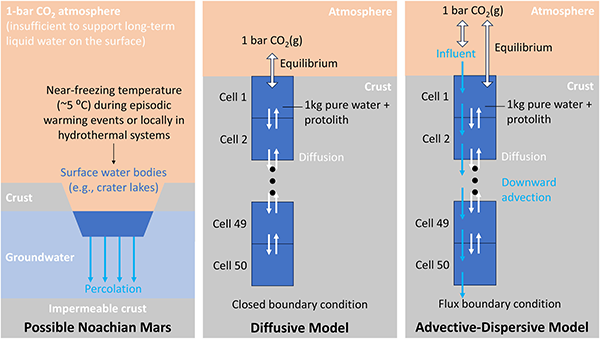
Chang-Chin Wang, a doctoral student at the University of Tokyo, led a study, with Associate Professor Mohit Melwani Daswani at ELSI, and Professor Tomohiro Usui at the University of Tokyo and JAXA, that asked whether protolith composition, the starting rock that water alters, could explain the calcium/iron-rich carbonates. The team built one-dimensional thermochemical models using a geochemical code to simulate water percolating through columns of either mafic or feldspar-rich rock under cold, carbon dioxide-rich conditions resembling those on ancient Mars. The models tracked how water chemistry evolved as it dissolved primary minerals and precipitated new ones, across both short bursts of alteration lasting a few years and longer episodes lasting up to 100,000 years, and under two modes of water movement: diffusion through standing water, and downward percolation mimicking groundwater flow.
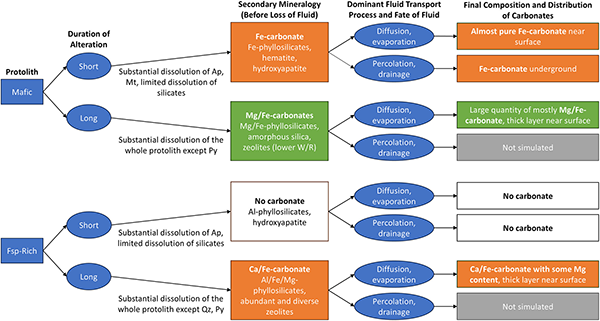
The simulations show that feldspar-rich rock readily produces calcium/iron-rich carbonates under most conditions tested, while mafic rock only does so during brief alteration, before enough magnesium-bearing minerals have dissolved to shift the chemistry toward magnesium-rich carbonates. This gives researchers a new way to interpret what is found at the Martian surface: where calcium/iron-rich carbonates appear without traces of olivine, a magnesium-rich mineral that survives only limited water-rock reaction, a feldspar-rich source rock becomes the more likely explanation. The team also found that percolating groundwater, as opposed to standing water, was far more efficient at forming carbonates, but tended to dissolve them again near the surface and reprecipitate them deeper underground. This offers a mechanism for why Mars may hold a substantial reservoir of carbonates, and the carbon dioxide locked within them, hidden below a surface that appears comparatively carbonate-poor. The findings suggest that the dichotomy in Martian carbonate composition is not only a record of climate and hydrology, but also a fingerprint of the crust that those waters once flowed through, and point toward feldspar-rich terrains and subsurface drilling as promising targets for future missions seeking buried evidence of the planet’s wetter past.
| Journal | Journal of Geophysical Research: Planets |
| Title of the paper | Alteration of Feldspar-Rich Rocks on Ancient Mars and Its Possible Link to Ca/Fe-Rich Carbonates |
| Author | C. Wang1*, T. Usui1,2, and M. Melwani Daswani3,4 |
| Affiliations | 1. Department of Earth and Planetary Science, Graduate School of Science, The University of Tokyo, Tokyo, Japan 2. Institute of Space and Astronautical Science, Japan Aerospace Exploration Agency, Sagamihara, Japan 3. The SETI Institute, Mountain View, CA, USA 4. Earth-Life Science Institute, Institute of Science Tokyo, Tokyo, Japan |
| DOI | https://doi.org/10.1029/2025JE009358 |
| Online published date | June 16 2026 |