
[This is a joint press release with the National Institute for Basic Biology]
Researchers propose a population-scale biosignature based on how life may spread between planets
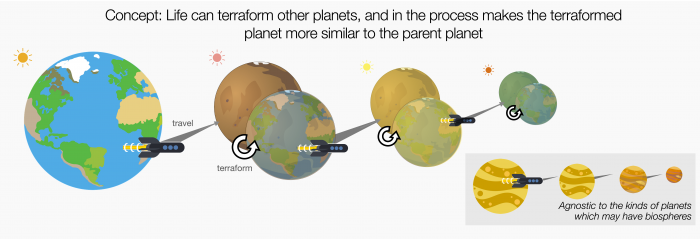
The concept behind the model is simple: life can travel to and terraform planets around other stars. In doing so, the planet that life travels to becomes more similar to the planet it came from. In this example, life from a planet resembling Earth travels to a red planet. The process plays out again and again. Each time, after being terraformed, a planet becomes more “Earth-like” than would be expected from random chance, given the locations of the planets. However, the focus is not on identifying Earth-like planets. Instead, the aim is to identify any group of planets that are more similar to each other than would be expected by chance, and are localised in space. This technique is agnostic: it does not require making assumptions about habitability or passing judgment on the “kinds of planets” that are amenable to life. Credit: Harrison B. Smith
A research team of Specially Appointed Associate Professor Harrison B. Smith of Earth-Life Science Institute (ELSI) at Institute of Science Tokyo and Specially Appointed Associate Professor Lana Sinapayen of National Institute for Basic Biology has developed a new approach to detecting life beyond Earth that does not rely on identifying specific biological markers. Instead, the study suggests that life may be detectable through patterns emerging across groups of planets, offering a new framework for astrobiology in situations where traditional biosignatures are ambiguous or unreliable.
One of the main challenges in astrobiology is establishing whether observed features of distant planets genuinely indicate the presence of life. Traditional biosignatures, such as atmospheric gases, can often produce false positives through non-biological processes. Although technosignatures might offer more reliable signals, they rely heavily on strong assumptions about the nature and behaviour of extraterrestrial intelligence.
To overcome these limitations, the researchers considered a fundamentally different idea: instead of searching for life on individual planets, what if life could be detected through its collective effects across many planets?
The study presents an “agnostic biosignature”—a method that does not rely on knowing in detail what life consists of or how it functions. Instead, it is based on two broad assumptions: that life can spread between planets (for example, through panspermia), and that it can modify planetary environments over time.
Using an agent-based simulation, the researchers modelled how life might spread across star systems and alter planetary characteristics. They discovered that if life extends and impacts planetary environments, it produces detectable statistical correlations between planet locations and their observable traits.
Crucially, these correlations appear even without pinpointing a particular biosignature on any individual planet.
Beyond detecting the presence of life, the researchers also developed a method to identify which planets are most likely to host it. By clustering planets based on their observable characteristics and spatial relationships, they were able to isolate groups of planets with a high probability of having been influenced by life.
This approach prioritises reliability over completeness: it minimises false positives, even if it misses some life-bearing planets. Such a strategy is especially useful for guiding follow-up observations with limited telescope time.
“By focusing on how life spreads and interacts with environments, we can search for it without needing a perfect definition or a single definitive signal,” said Harrison B. Smith. Lana Sinapayen added, “Even if life elsewhere is fundamentally different from life on Earth, its large-scale effects, such as spreading and modifying planets, may still leave detectable traces. That’s what makes this approach compelling.”
The findings indicate that future astronomical surveys, which will observe large numbers of exoplanets, could employ statistical methods to detect life on a population level. This approach might be especially useful when individual biosignatures are faint, ambiguous, or susceptible to false positives.
The study also highlights the importance of better understanding the baseline diversity of planets formed without life, as this will improve the reliability of detecting deviations caused by biological processes.
While the current work relies on simulations, it provides a conceptual basis for a new category of life-detection methods. The researchers emphasise that future efforts must incorporate more realistic planetary data and galactic dynamics. Nevertheless, the results suggest that life could be detectable even without understanding its chemistry, by recognising the patterns it leaves throughout the cosmos.
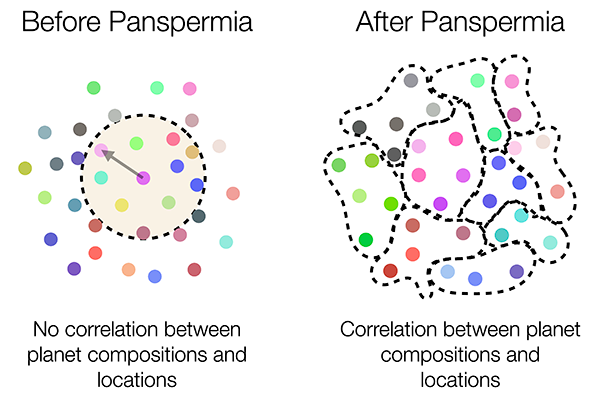
If life can travel to other planets and terraform them, it is expected that patterns will emerge between the locations of planets and their observable characteristics (for example, atmospheric composition). On the left, planets (coloured dots) show no correlation between their locations and their characteristics (represented by colour). However, if life capable of panspermia and terraforming arises, then correlations emerge (shown as dashed line groups of similar colours). In the model, life chooses its destination by looking for the planet with the most similar composition within some maximum distance (shown on the left by a dashed circle). Credit: Harrison B. Smith
ReferenceHarrison B. Smith1, 2, ∗ and Lana Sinapayen3, 4, †, An Agnostic Biosignature Based on Modeling Panspermia and Terraforming, The Astrophysical Journal, DOI: 10.3847/1538-4357/ae4ee3
- Earth-Life Science Institute, Institute of Science Tokyo, Ookayama, Meguro-ku, Tokyo, Japan
- Blue Marble Space, Seattle, Washington, USA
- Sony Computer Science Laboratories, Kyoto, Japan
- National Institute for Basic Biology, Okazaki, Japan
*Corresponding author’s email: hbs@elsi.jp
Contacts:
Thilina Heenatigala
Director of Communications
Earth-Life Science Institute (ELSI),
Institute of Science Tokyo
E-mail: thilinah@elsi.jp
Tel: +81-3-5734-3163 / Fax: +81-3-5734-3416
Harrison B. Smith
Specially Appointed Associate Professor
Earth-Life Science Institute (ELSI),
Institute of Science Tokyo
E-mail: hbs@elsi.jp